
This is Part 2 of our Core Identity Model series.
Most chiropractors focus on what they do. But sustainable success starts with who you are. Your Core Identity bridges that gap—aligning your deepest values with your daily performance.
Part 1 explores the Inner Nucleus: the deep structures that define who you are.
Part 2 explores the Outer Shell: the high-performance habits that turn your identity into consistent action.
From Being to Doing
In Part 1, we explored your Inner Nucleus—the gravitational center of your professional identity made up of four crucial components:
- Purpose
- Principles, Beliefs, and Values
- Strategic Vision
- Mission
But here’s the reality: identity alone isn’t enough.
I’ve worked with chiropractors who have crystal-clear purpose and rock-solid values, yet still struggle to show up consistently at their best. They know who they are, but they haven’t developed the skills to bring their best to their work consistently—especially when challenges arise.
This is where the Outer Shell comes in. The Outer Shell is about putting the conceptual clarity of your Inner Nucleus to work in your practice so you can reach your potential as a leader.
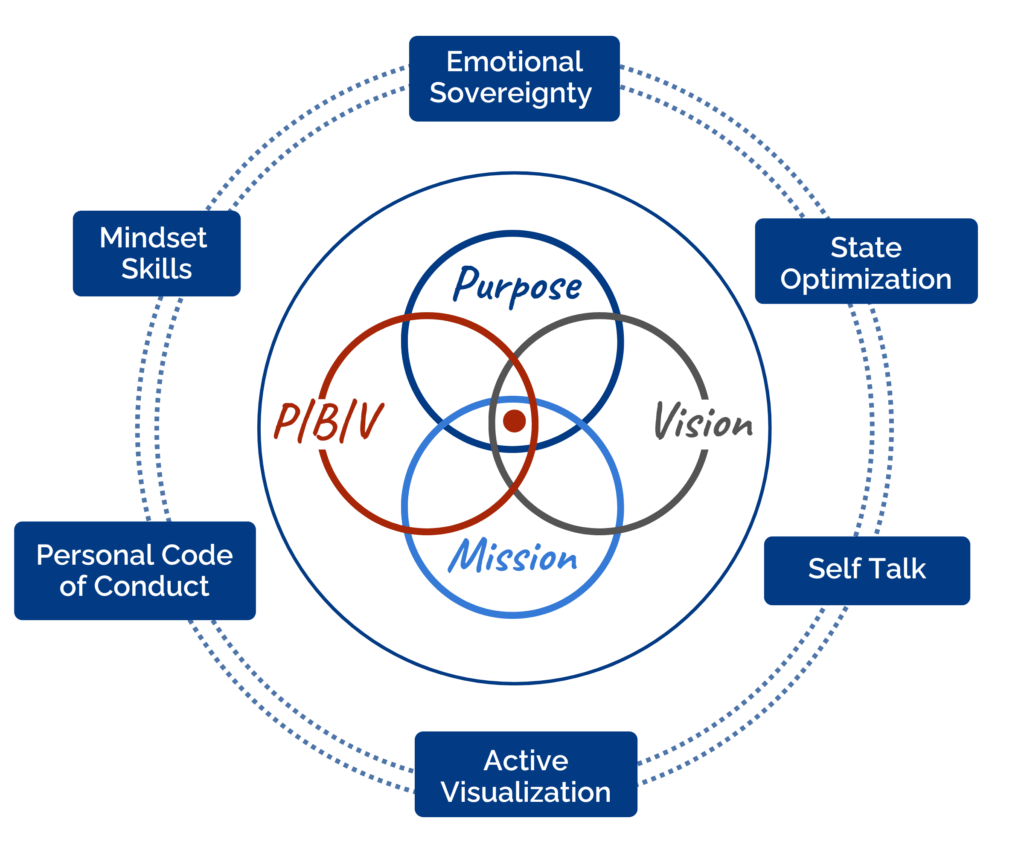
The Core Identity Model: Your Inner Nucleus (center) provides the foundation for your Outer Shell tools and behaviors.
The Outer Shell represents the high-performance habits and psychological tools that translate your identity into consistent, actionable excellence. It’s what enables you to embody your values and serve your purpose, even when the day gets chaotic or stress mounts.
If the Inner Nucleus is your engine, the Outer Shell is your vehicle—the visible expression of your internal power.
The Six Tools of Peak Performance
The Outer Shell consists of six interlocking elements. Think of them as your performance toolkit—each one designed to help you access your best self on command.
1. Emotional Sovereignty: The Space Between Trigger and Response
Emotional sovereignty is your ability to exert control over your response to challenging moments in your practice. It is a skill that allows you to create space between experiencing an adverse emotion and reacting to it.
It’s not about avoiding or suppressing difficult emotions—it’s about training yourself not to be hijacked by them. When stress, frustration, or anxiety arises (and it will in practice), emotional sovereignty allows you to pause, observe what you’re feeling, and then respond from your Core Identity rather than react from the emotional impulse.
This is the difference between leadership and reactivity.
Chiropractic practice is full of emotional triggers: challenging patients, unexpected setbacks, financial pressures, difficult conversations with team members. Without emotional sovereignty, these moments control you—your emotions dictate your behavior, often in ways that conflict with your values and purpose.
With emotional sovereignty, you remain the author of your response. You feel the emotion, acknowledge it, breathe through it, and then choose how to respond based on who you are, not what you’re feeling in the moment.
The technique is simple but powerful:
- Identify – Notice the emotion arising (“I’m feeling frustrated”).
- Observe – Step back mentally and watch the feeling without judgment.
- Breathe – Take a conscious breath to create space.
- Respond – Act from your Core Identity, not the emotional impulse.
This practice transforms you from someone who gets triggered by circumstances into someone who responds with intention and wisdom—exactly what patients and teams need from their leader.
2. State Optimization: The Channel You’re Broadcasting On
Your state is your moment-to-moment internal environment—the mental, emotional, and physical factors that shape how you think, feel, and act in every interaction.
It’s the channel you’re broadcasting on, and every patient who walks into your practice is tuning into that signal.
Your state determines your presence, your clarity, your ability to lead conversations, connect authentically, and adjust with purpose. When your state is optimized, you feel alert, focused, confident, and resourceful—the ideal condition for peak performance.
The best chiropractors learn to harness their state on command. That’s a major aspect of what sets them apart.
Your state is shaped by three key variables, each of which can be consciously influenced:
- Psychology: What you’re focused on, how confident you feel, and your level of internal motivation.
- Emotional Tone: The energy you’re bringing to each moment, your level of emotional activation, and whether you’re calm, reactive, or positively engaged.
- Physiology: Your arousal level, breath quality, posture, muscle tone, and physical readiness.
Here’s what most chiropractors don’t realize: each of these elements is an access point. When you understand how to shift them intentionally, you gain the ability to shift your entire state.
This means you’re no longer at the mercy of your circumstances, your schedule, or your mood. Instead, you can consciously choose the internal environment that serves your patients and your practice best.
3. Self-Talk: Your Internal Performance Coach
Your self-talk creates your internal reality. It shapes how you perceive challenges, process setbacks, and project confidence to others.
Here’s what most people don’t realize: you’re already talking to yourself all day long. The question is whether that voice is sabotaging your performance or fueling it.
Negative self-talk can destroy your state instantly. Empowering self-talk turns pressure into fuel and obstacles into opportunities.
As a chiropractor, you’re constantly performing—adjusting patients, communicating complex concepts, leading difficult conversations. Your internal dialogue must support, not undermine, that performance.
4. Active Visualization: Mental Rehearsal for Excellence
Visualization isn’t wishful thinking—it’s systematic mental rehearsal.
When you visualize scenarios vividly and repeatedly, your nervous system encodes them almost as if they were real experiences. This primes your brain and body to execute with confidence and precision when the actual moment arrives.
Elite athletes use visualization to enhance performance. Top chiropractors can do the same.
Whether it’s visualizing challenging patient consultations, report of findings presentations, or simply the flow of an ideal day, this tool helps you perform better by practicing in your mind first.
5. Mindset Skills: Your Psychological Shock Absorbers
While the previous tools are practices you use, mindset skills are capacities you build over time:
Calmness under pressure
Unshakeable self-confidence
Laser-focused attention
Grit and perseverance
These skills act as your psychological shock absorbers, allowing you to stay consistent and effective even when conditions are messy, uncertain, or stressful.
They’re the difference between surviving difficult days and thriving through them.
6. Personal Code of Conduct: Your Identity in Three Words
Your Personal Code of Conduct is where the Outer Shell connects directly back to your Inner Nucleus.
It’s a simple yet powerful declaration that represents how you endeavor to conduct yourself in practice—a one-sentence statement that captures who you are and how you act when you’re expressing the best version of yourself.
This isn’t a list of rules or policies. It’s an aspirational statement of your ideal professional identity.
Think of someone you deeply respect in chiropractic—someone who exemplifies the way you want to show up professionally. How do they treat patients? How do they lead their team? What specific qualities do they embody that inspire you?
Now imagine yourself operating at that same level. What are the core “ways of being” that define you at your best?
Your Personal Code of Conduct distills this vision into three powerful words or phrases using this simple structure:
“My Personal Code of Conduct is to be ______________, ______________, and ___________________.”
Examples might include:
- “My Personal Code of Conduct is to be disciplined, focused, and relentless.”
- “My Personal Code of Conduct is to be caring, understanding, and present.”
- “My Personal Code of Conduct is to be energized, positive, and authentic.”
This becomes your behavioral compass—a quick reference point for decision-making and a standard for evaluating whether you’re showing up as your highest self.
When challenges arise, when you’re having an off day, or when you need to reset your approach, your Personal Code of Conduct reminds you exactly who you’ve committed to being.
It’s your Core Identity made actionable, and it ensures that your Inner Nucleus finds consistent expression through your daily actions.
Why the Outer Shell Transforms Everything
The Outer Shell is what makes your Core Identity visible and operational in the real world.
It transforms your purpose into presence that patients can feel the moment they walk through your door.
It turns your vision into consistent, intentional action that builds trust and creates results.
It helps you carry your mission through the inevitable ups and downs of daily practice with unwavering consistency.
Without the Outer Shell, even the strongest Inner Nucleus remains locked inside—known to you but invisible to those you serve.
And just like the protective shell of a nucleus, these tools also shield you from external chaos, preventing circumstances from destabilizing your internal clarity and derailing your performance.
The Integration That Creates Unstoppable Leadership
The Core Identity Model works because it integrates two essential dimensions of peak performance:
The Inner Nucleus (Being) → Who you are at your core
The Outer Shell (Doing) → How you show up and perform consistently
Most chiropractors skip straight to tactics, scripts, and marketing strategies. But without a strong Inner Nucleus, those tools feel inauthentic and don’t create lasting change. And without Outer Shell skills, your inner identity never gets fully expressed or experienced by others.
True, sustained excellence requires both dimensions working in alignment.
When your Inner Nucleus and Outer Shell are integrated, something powerful happens: you stop performing and start being. Your work becomes the natural expression of your highest self in service of others.
Your Next Step: Begin Building Systematically
The most successful chiropractors I work with didn’t develop their Core Identity overnight. They built it systematically, one element at a time.
Here’s how to start:
- Anchor deeply in your Inner Nucleus first (review Part 1 if you haven’t already).
- Choose one Outer Shell tool that addresses your biggest current challenge.
- Practice it consistently for 30 days until it becomes second nature.
- Layer in the next tool and repeat the process.
Remember: the goal isn’t perfection—it’s integration. You want these tools to become so natural that using them requires no conscious effort, leaving your full attention available for leading your team and serving your patients at the highest level.
The Foundation of Lasting Impact
Your Core Identity—Inner Nucleus plus Outer Shell—represents more than just practice success. It’s the deepest foundation for creating lasting impact in the lives you touch.
It’s also the most renewable source of energy, motivation, and professional fulfillment you’ll ever discover.
Because when who you are and how you perform are perfectly aligned, work stops feeling like work. It becomes your calling expressed through excellence, your purpose made visible through consistent leadership.
And that’s when both your practice and your life transform from good to truly extraordinary.